
Victorian election 2026
The Victorian state election on 28 November 2026 is a chance for Victorian decision-makers to take action so all Victorian renters can live with dignity in safe, secure and affordable homes.
We’re calling on all political parties and candidates, both current and incoming, to commit to stronger protections for the 2 million Victorians who rent their homes.
Dignity election platform

Ahead of the 2026 election, we’re campaigning to strengthen dignity in renting. Our Dignity platform asks all political parties and candidates to commit to 4 key asks, that, together, would give every Victorian the dignity they expect in their home.
Our 4 asks:
- Lock in renters’ rights
- No renter should miss out on basic protections
- Drive compliance with rental minimum standards and help landlords understand their role
- Give renters the confidence to challenge unfair rent increases
Read more about each ask below or download our platform: Victorian election Dignity platform.
Everything starts with a home where you and your family are safe and protected. It’s the foundation for building your life, a place where you can reset for another day or your next adventure.
Renters’ rights make it possible for us to make a house our home. Victoria’s political parties should commit to preserving these protections, so that the 1 in 3 Victorians who rent experience dignity living in safe and secure homes.
Every Victorian renter should live in a safe home that meets all the new minimum standards and be protected by all the latest rental law reforms.
Currently, renters who started their lease before 29 March 2021 – nearly 30% of private renters (as at June 2024) – are missing out on key rental minimum standards.
Political parties must commit to closing this legal loophole to make sure that all renters can make their rental house a home.
Renters have a right to safe and comfortable homes, with landlords who understand and comply with the law.
Currently, too many rental properties don’t meet minimum standards, and many landlords don’t understand their obligations. Developing a registration scheme for rental homes will help renters and regulators know whether a property meets minimum standards.
Renters should be able to negotiate or challenge a rent increase with confidence.
Currently, when a renter gets a rent increase, it’s hard to know if it’s considered too high. The next Victorian Government should fund and work with renting experts to create an online excessive rent increase checker, so people can confidently challenge unfair rent increases.
Snapshot of renting in each electorate
To accompany our election platform, we have created renting profiles for every district electorate and Upper House region in Victoria.
These profiles answer questions such as:
- How many households in my area rent?
- How many people in my area have been supported by Tenants Victoria?
- What issues are they experiencing?
Find your electorate below and click to download a profile of your area. Not sure what electorate you fall under? Type your address into the Victorian Electoral Commission tool. Your lower house electorate ends in district and your upper house electorate ends in region.
Electorate profiles
Upper house regional profiles
There are 8 electoral regions in Victoria, each with 5 representatives in Victoria’s Legislative Council. Click your region to download your regional profile.
- Eastern Victoria Region
- North-Eastern Metropolitan Region
- Northern Metropolitan Region
- Northern Victoria Region
- South-Eastern Metropolitan Region
- Southern Metropolitan Region
- Western Metropolitan Region
- Western Victoria Region
About the data
Top 10 issues renters contacted Tenants Victoria about shows the most common issues renters in this electorate sought help with through Tenants Victoria’s information services, including our phone line and web chat service. The chart compares the proportion of enquiries relating to each issue in this electorate with the proportion across Victoria as a whole, highlighting where local renters’ experiences differ from the statewide picture.
Totals in electorate profiles may amount to greater than 100% as renters may seek assistance with multiple different or related issues.
Please note that our financial counselling and social work outreach services expanded from 2024.
Data on the number of renting households in each electorate comes from the 2021 census: Australian Bureau of Statistics (ABS), 2021 Census of Population and Housing.
Where renters need support
Renters seeking support through our website
Renters turn to Tenants Victoria’s website when they need to know about the protections and responsibilities they have.
Between late 2022 and August 2026, nearly 2 million people visited our website to learn about their rights and take action on a rental issue.
The issues attracting the most attention reveal the pressures renters face every day. The most visited pages covered ending or breaking a lease, notices to vacate and eviction, and what happens when a rental property is being sold.
Download our Victorian Renters’ Top Searched Renting Issues profile to explore what renters are searching for most.
Renters seeking support through our phone line and legal services
When renters need help they turn to Tenants Victoria’s phone line and legal services.
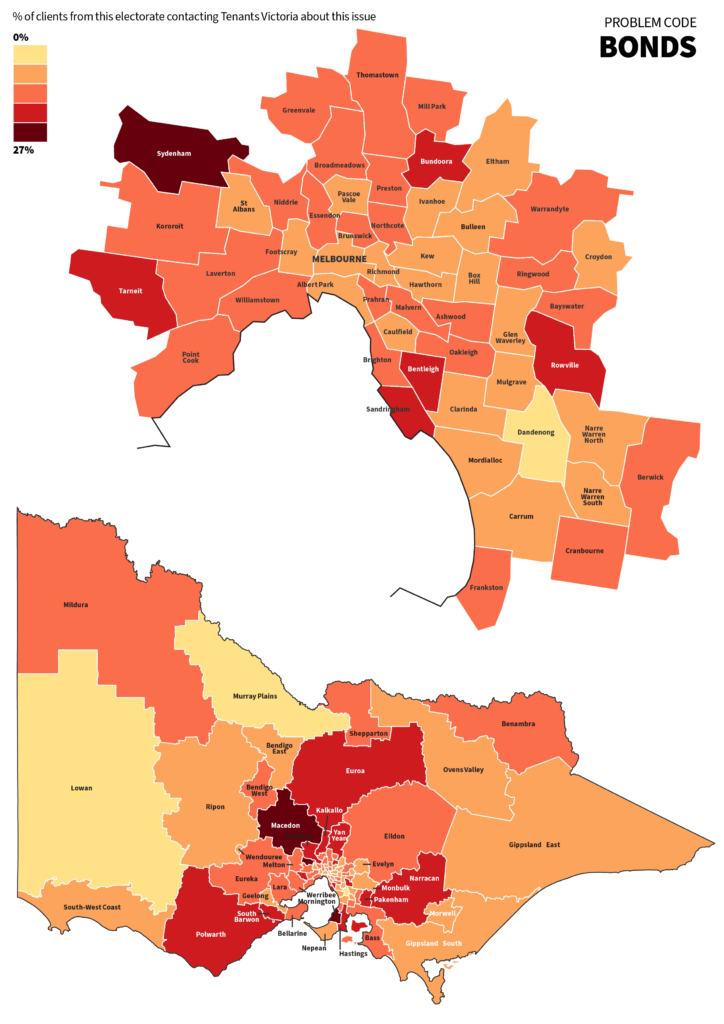
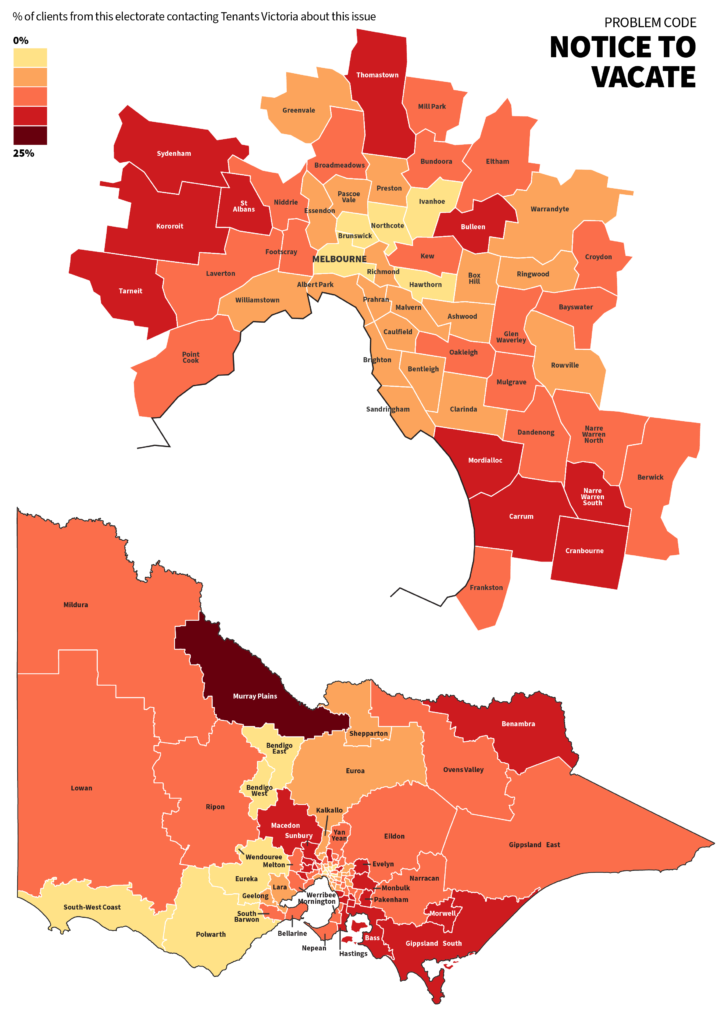
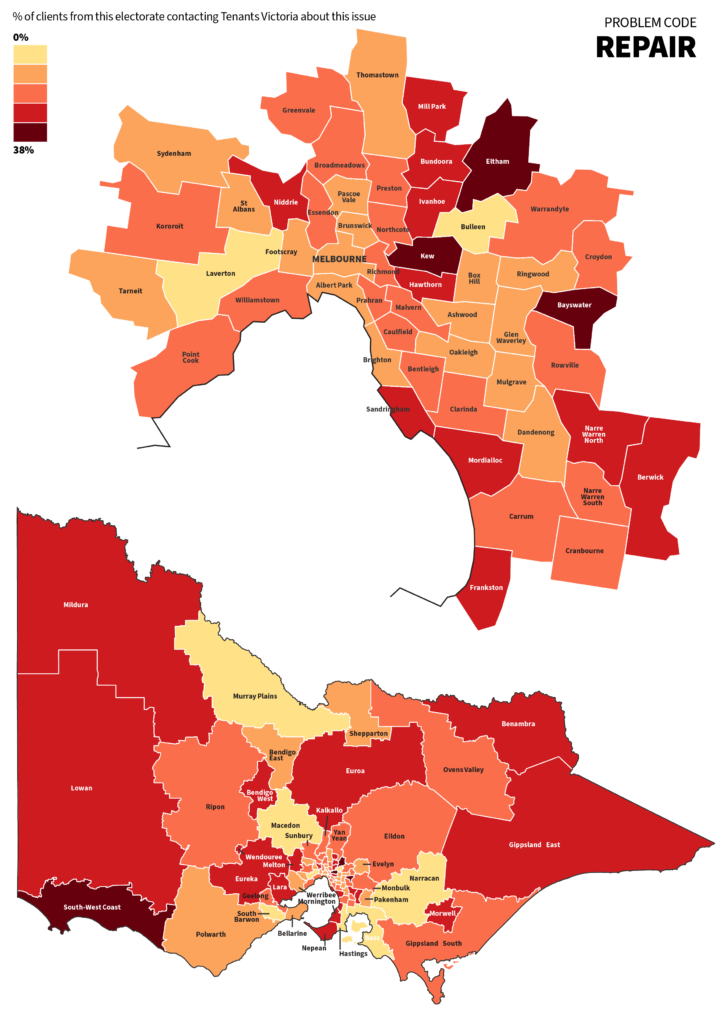
Our analysis highlights hotspots where renters disproportionately experience issues with notices to vacate, repairs, and bond disputes.
Click on the heatmaps to zoom in to each area.
Notices to vacate
A ‘notice to vacate’ is a request in writing from your landlord (officially called the rental provider) or their agent asking you to move out.
Reasons for a notice to vacate can range from the landlord wanting to do something with the property to the landlord saying you have done something wrong.
You can learn more about your rights after receiving a notice to vacate on our Notices to vacate and eviction page.
Repairs and maintenance issues
The law says your landlord (officially called the rental provider) must keep your rented home in ‘good repair’. It doesn’t matter how old it is, what it was like when you moved in, or how much rent you pay.
If you are having trouble getting your landlord or their agent to do repairs, there are steps you can take to move things along.
You can learn about the steps to take if you need repairs on our Repairs and maintenance page.
Bond-related disputes
A bond is money you may be asked to pay when you rent a home. It’s held in case there is a dispute over things like damage, cleaning or unpaid rent when you move out. The Residential Tenancies Bond Authority (RTBA) holds your bond until you leave.
You can learn more about how to get your bond back on our bonds page.